A contactor that matches a motor’s kilowatt rating can still be wrong for its voltage, starting current, switching frequency, control circuit, or short-circuit environment. By the end, you will be able to give a dealer the operating data needed for a defensible selection and compare quotations based on a complete, coordinated starter rather than an ampere number alone.
Key takeaways
- Give the dealer motor nameplate current and the actual switching cycle.
- Check utilisation category, thermal current, coil voltage and auxiliary contacts separately.
- Choose the starting method before selecting the contactor rating.
- Demand coordinated protection, overload settings and documented technical support.
Start with the Motor Nameplate and the Real Switching Duty
Give the dealer the motor’s nameplate data and a description of how you will switch it; horsepower alone cannot size a contactor. Motor nameplate current is the starting point, not a catalogue kW guess.
- State the rated voltage, frequency, phase, and full-load current. Identify whether the motor operates on 230 V or 415 V, and give the exact motor nameplate current.
- Specify the starting method: direct-on-line, star-delta, soft starter, variable-frequency drive, reversing, or inching and jogging. Include the driven load, such as a pump, compressor, conveyor, or fan.
- Give the expected starts per hour, running hours, duty cycle, and whether switching occurs under normal running, plugging, or frequent reversal.
- Provide the control-circuit voltage and frequency, such as a 50 Hz AC supply, and state whether the contactor coil must be AC or DC. List required auxiliary contacts.
Ask for an AC-3 contactor rating at your actual voltage and current for a squirrel-cage motor. AC-3 covers closing during starting and opening after the motor reaches speed; AC-1 is intended mainly for resistive or lightly inductive loads and cannot validate motor switching.
Request the utilisation category, rated operational current, voltage, motor duty, and expected electrical endurance at your switching frequency. Frequent jogging or reversing can consume electrical life far faster than a headline mechanical-operations figure.
Read Utilisation, Thermal, Coil and Auxiliary Ratings Separately
A suitable contactor must match the motor’s nameplate current at the actual voltage and frequency, not just its kilowatt or horsepower label.
Confirm the rated operational current and utilisation category: AC-3 suits squirrel-cage motors that close during starting and open at running speed; AC-1 applies to resistive or slightly inductive loads and cannot validate motor switching; AC-4 covers inching, plugging, and frequent jogging, which cause faster contact wear.
Check these ratings independently:
- Utilisation rating: Verify the AC-3 or AC-4 current at 230 V or 415 V, 50 Hz, as applicable to the motor circuit.
- Thermal current rating: Use this for the continuous heating limit, not as proof that the contactor can interrupt a starting motor.
- Coil rating: Match the coil’s AC or DC type, voltage, and frequency to the available control supply. A 230 V AC coil is not interchangeable with a 24 V DC coil.
- Auxiliary rating: Confirm the auxiliary contact’s current, voltage, normally open or normally closed arrangement, and timing for interlocks or signalling.
The contactor does not provide overload protection. Select an overload relay whose adjustment range includes the nameplate current and whose trip class suits starting time and motor heating. Also verify the complete starter’s short-circuit coordination and SCCR; the contactor’s individual marking does not establish the assembled panel’s rating.
Ask for the exact datasheet, approved overload combination, wiring information, and compatible replacement coil and contact-kit numbers.
Choose the Starting and Switching Method Before Choosing the Contactor
The motor’s acceleration time, starting current and speed-control need decide the architecture before you select a contactor. Use this comparison:
| Method | What it does | When it applies |
|---|---|---|
| Direct-on-line starter | Applies full line voltage through a contactor | Small or stiff-supply installations where high inrush and full starting torque are acceptable |
| Star-delta starter | Starts in star, then changes to delta | Motors with six accessible terminals and light-to-moderate starting torque requirements; it reduces starting current but also reduces starting torque |
| Soft starter | Ramps voltage electronically during acceleration and deceleration | Pumps, fans and conveyors needing lower mechanical shock or reduced voltage drop without continuous speed control |
| Variable-frequency drive | Controls frequency and voltage for controlled acceleration and variable speed | Applications needing speed regulation, frequent starts, energy control or high starting torque at low speed |
| Contactor-based arrangement | Switches a motor or load on and off without electronic ramping | Simple fixed-speed duty, provided the supply can tolerate starting current |
A star-delta starter is a poor choice for a heavily loaded conveyor: the reduced star torque can leave the motor stalled during changeover. A soft starter does not provide the speed range of a variable-frequency drive.
For plugging, inching, jogging or frequent reversing, ask for the contactor’s AC-4 rating and an operations-per-hour calculation. For any arrangement, pair the contactor with a separately coordinated overload relay or approved integrated protection; the contactor alone cannot protect the motor.
Follow the drive manufacturer’s instructions for input, bypass and output contactors, and never open a VFD output while it is producing power.
Buy a Coordinated Motor Starter, Not Isolated Components
A contactor that carries the motor’s running current can still leave the motor unprotected. Buy a tested starter combination in which the contactor, overload relay and short-circuit protective device are approved to work together.
Match these points before ordering:
- Select the contactor for the motor’s utilisation category and switching duty, not only its ampere rating.
- Set the overload relay within a range that includes the motor nameplate full-load current. Choose its trip class from the actual starting time and motor thermal limits: Class 10 suits shorter starts, while Class 20 allows a longer start only when the motor manufacturer permits it.
- Use a tested fuse or circuit-breaker combination for short-circuit protection. A motor-protection circuit breaker can provide overload and short-circuit functions when its adjustment range, breaking capacity and coordination data suit the motor circuit.
- Require the dealer to identify the exact contactor, overload device and protective device as one tested combination, including the permitted upstream fuse or breaker.
Short-circuit coordination is separate from normal switching. Under IEC practice, Type 1 coordination permits specified component damage after a fault; Type 2 keeps the starter suitable for further service, subject to permitted contact welding.
For North American equipment, verify the complete assembly’s SCCR against the available fault current; a contactor’s individual SCCR does not establish the panel’s SCCR.
For reversing duty, specify a mechanically and electrically interlocked pair or a tested reversing assembly. PLC logic alone cannot prevent both contactors closing during a fault.
Test the Dealer’s Technical Support Before You Place the Order
Ask the dealer for evidence that the proposed contactor works in your complete starter, not just a catalogue page showing amps and mounting dimensions.
1. Request the exact product datasheet, terminal layout, wiring diagram, coil burden, auxiliary-contact ratings, and conformity or certification documents for your market. Also request short-circuit coordination data for the contactor, overload relay, and protective device as one tested combination.
Under IEC practice, Type 1 coordination allows specified component damage after a fault; Type 2 coordination keeps the starter suitable for further service, subject to permitted contact welding.
2. Give the dealer the installation conditions: ambient temperature, altitude, enclosure rating, humidity, dust or chemical exposure, supply frequency, and control voltage. Ask for any derating or coil-suppression requirement. For North American equipment, verify the complete assembly’s SCCR against the available fault current; an individual contactor’s SCCR does not establish the panel SCCR.
3. Ask for the compatible overload-relay part number, adjustment range, and trip class, then obtain replacement-coil and contact-kit part numbers. Confirm whether those parts remain available and whether a reversing starter includes both mechanical and electrical interlocking.
Contact Electrical & Automation Pvt Ltd can add value during selection if it checks these documents and tested combinations rather than matching a replacement by frame size alone. Coil burden, auxiliary-contact timing, terminal positions, and approved overload compatibility can differ between apparently interchangeable devices. Get those details in writing before placing the order.
Related products
 | MOTORS CONTROL PRODUCTS Power Contactor, Control Contactor View product → |
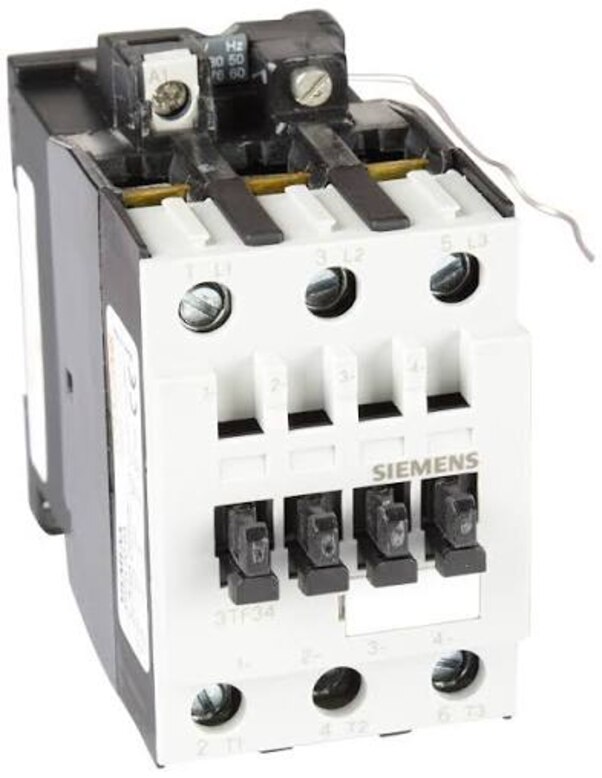
 | Contactor Contactor Siemens make Power Contactor AC3 32 AMP |
Frequently asked questions
What information should you give a contactor dealer?
Provide the motor nameplate voltage, full-load current, frequency, power, duty, starting method and switching frequency. Explain whether the contactor switches a motor, heater, capacitor bank or another load.
Which contactor ratings must you compare?
Compare the utilisation category, such as AC-3 or AC-4, rated operational current, thermal current, coil voltage, auxiliary-contact ratings and short-circuit coordination data.
Why choose the starting method before the contactor?
Direct-on-line, star-delta, reversing, soft-start and variable-frequency-drive systems impose different switching duties and require different contactor arrangements.
What should a coordinated motor starter include?
A coordinated starter matches the contactor with short-circuit protection, an overload relay, control components and the motor’s starting method. Ask for wiring diagrams, settings and coordination details.