A low quotation is not useful if it is based on the wrong panel type, an unverified fault rating, incomplete heat calculations, or unclear commissioning responsibility. Start with the project data, write measurable requirements into the RFQ, and compare suppliers on verified engineering, testing, documentation, and support rather than price alone.
Key takeaways
- Issue every supplier the same load schedule, fault level, and site conditions.
- Specify ratings, enclosure protection, temperature, short-circuit withstand, and expansion space.
- Request design calculations, protection coordination, type-test evidence, and factory acceptance tests.
- Compare scope ownership, exclusions, spares, drawings, test records, and commissioning support.
Start with the project data and identify the panel you actually need
A quotation is only comparable when every supplier prices the same duty. Start with the project load schedule, single-line diagram, fault level, motor list, utility incomer, required expansion allowance, and site conditions.
1. Confirm the electrical data before contacting suppliers. Record rated voltage, frequency, maximum and diversified load, motor starting method, available fault current at the panel, earthing arrangement, incoming and outgoing cable sizes, and whether future feeders or spare ways are required.
Add ambient temperature, altitude, dust, moisture, corrosive atmosphere, indoor or outdoor location, and cable-entry direction.
2.
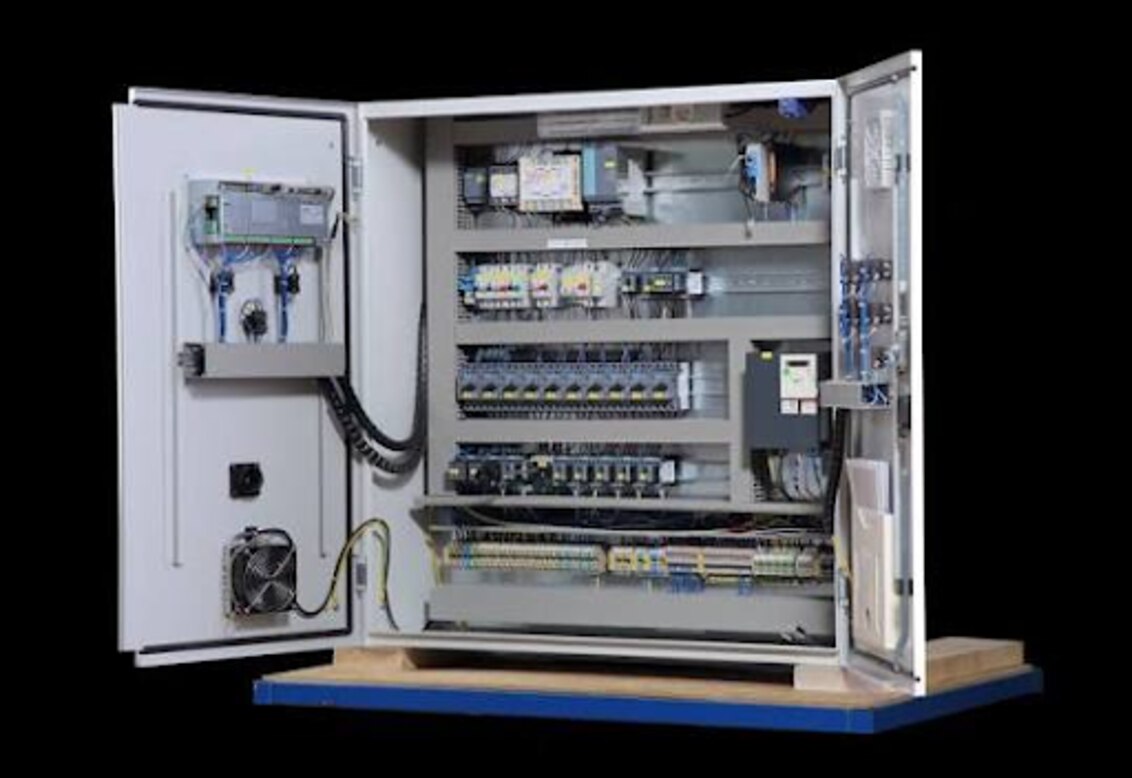
Name the panel by its function, not by a vague term such as “control panel.” A distribution board feeds final circuits; a power control centre (PCC) handles major distribution; a motor control centre (MCC) houses motor starters; a VFD panel contains drives; a synchronising panel manages generator or utility paralleling; a PLC control panel handles automation; an APFC panel corrects power factor; and a packaged control panel serves one defined machine or process.
3. State the required assembly classification in the enquiry. Specify the rated operational voltage, insulation voltage, busbar current, prospective short-circuit current, rated short-time withstand current (Icw), peak withstand current (Ipk), ingress-protection rating, form of internal separation, enclosure material, and spare capacity. Ask suppliers to identify exclusions, site interfaces, and the exact documents included with handover.
Put measurable electrical and environmental requirements in the RFQ
State the electrical values, fault levels, construction, and site conditions in the RFQ; otherwise each supplier prices a different panel. Specify the rated operational voltage, frequency, insulation voltage, busbar current, phase arrangement, neutral and earth-bus sizes, spare capacity, and cable-entry direction.
Require each quotation to state:
- Short-circuit data: prospective short-circuit current at the incoming terminals, Icw short-time withstand current with its duration, Ipk peak withstand current, and Icc conditional short-circuit current or SCCR where the protective device establishes the condition.
- Construction: IEC 61439 assembly classification, form of internal separation, enclosure material, dimensions, access arrangement, and whether the panel is a distribution board, MCC, PCC, or control panel.
- Environment: enclosure rating to IEC 60529, such as IP54 or IP65, or a specified NEMA type; ambient temperature range, altitude, humidity, dust, oil, chemical exposure, corrosion, indoor or outdoor installation, and cooling method.
- Installation: utility fault level, earthing system, cable sizes, termination space, incoming and outgoing cable locations, and the available working distance for arc-flash assessment.
Use the correct product standard. UL 508A for industrial control panels is not interchangeable with UL 891 switchboards or UL 1558 switchgear.
| Short-circuit figure | What it describes | What to demand |
|---|---|---|
| Icw | Assembly withstand for a stated time | Value and duration, such as 50 kA for 1 s |
| Ipk | Assembly peak withstand | Peak current in kA |
| SCCR or Icc | Conditional assembly rating | Protective device and test basis |
A generic arc-flash label does not replace site-specific fault-current and clearing-time data.
Check the supplier’s design calculations and component coordination
Ask for the calculation package, not a brochure. It should show how the proposed assembly handles the project’s maximum load and fault level. For IEC 61439, request the declared Icw, Ipk peak withstand current, and Icc conditional short-circuit current, plus the protection device and design-verification basis behind each value.
A breaker’s interrupting rating alone does not prove that the completed panel can withstand the fault. In North American work, ask for the assembly’s SCCR marking and UL 508A Supplement SB calculation where applicable.
Check the package for these items:
- Busbar sizing against continuous current, fault forces, allowable temperature, and expansion allowance; confirm joints, supports, and clearances.
- Temperature rise and heat-dissipation calculations using the actual enclosure, ambient temperature, bus loading, breakers, contactors, transformers, drives, and ventilation. A catalogue current rating is not automatically valid inside a crowded panel.
- Voltage-drop figures for long feeder runs and motor starting, with the assumed cable lengths and conductor sizes stated.
- Time-current curves or coordination tables for every upstream and downstream protective-device combination. Check instantaneous-trip settings; they can destroy selectivity even when long-time settings coordinate.
- Spare ways, terminals, control power, and thermal capacity for the stated expansion requirement. Empty space without electrical capacity is not a usable spare.
- Design-verification evidence for the supplier’s actual assembly, identifying differences from any tested reference design.
Require final calculations, protection settings, editable schematics, terminal schedules, and component data at handover. Without them, fault-finding and later modifications become slower and riskier.
Demand the right standards, verification records, and factory tests
Ask for an evidence pack that identifies the completed panel as an assembly, not a box containing individually rated parts. Under IEC 61439, the assembly manufacturer is responsible for design verification and routine verification, even when it integrates breakers, busbars, contactors, and enclosures from different manufacturers.
Request these records before approval:
- A design-verification report covering temperature rise, short-circuit withstand, clearances, creepage distances, protection circuits, and mechanical construction.
- The type-design verification reference, including the tested configuration and every difference between that reference and your proposed panel.
- Signed routine verification results for the actual completed panel.
- A factory acceptance test procedure and signed results, linked to the panel serial number and drawing revision.
- Final single-line diagrams, control schematics, terminal plans, component schedules, nameplate details, and approved setting sheets.
| Evidence | What it proves | What it does not replace |
|---|---|---|
| IEC 61439 design verification | The design satisfies assembly-level construction and performance requirements | Routine verification of the finished panel |
| Routine verification | The supplied panel was checked for workmanship, wiring, protective continuity, dielectric performance, and operation | Design verification |
| Factory acceptance test | The agreed FAT checks were actually performed, including point-to-point wiring, interlocks, sequences, alarms, communications, settings, and nameplates | IEC 61439 verification |
| North American SCCR record | The marked short-circuit rating applies to the complete panel, not only a breaker | UL 508A construction evidence |
A FAT report alone does not prove compliance with IEC 61439. Require the supplier to state Icw, Ipk, or Icc as applicable, rather than quoting only a component interrupting rating.
Compare supplier responsibility, quotation value, and long-term handover
Compare suppliers on the risk they retain, not on the number of familiar brands in the quotation. A low price loses its value if exclusions push design, testing, commissioning, or fault investigation back to your team.
| Criterion | Supplier A | Supplier B | Evidence to compare |
|---|---|---|---|
| Design responsibility | Names the assembly manufacturer and IEC 61439 verification basis | Lists components but leaves integration responsibility unclear | Signed design-verification references, calculations, deviations |
| Protection performance | Provides protection coordination, SCCR, and selective coordination results | Offers a brand-based “coordinated” claim | Time-current curves or coordination tables for actual fault levels and settings |
| Scope and substitutions | Includes enclosure accessories, wiring, testing, spares, and approved alternatives | Uses “equal or approved” substitutions without rechecking | Inclusion schedule and written buyer-approval clause |
| Site support | Includes installation checks, commissioning, training, and fault rectification | Delivers the panel only | Named activities, hours, response times, and warranty exclusions |
| Handover | Supplies editable drawings and complete settings and test records | Supplies a PDF drawing pack | File register, source files, firmware versions, terminal schedules, and communication maps |
Treat a substitute breaker, contactor, fuse, power supply, drive, or communication module as a design change. Require re-verification of SCCR, heat dissipation, clearances, EMC behaviour, coordination, and firmware compatibility before approval.
For a project using Contact Electrical & Automation Pvt Ltd, apply the same test: obtain the final single-line diagram, protection settings, heat or load calculations, test records, and editable schematics before releasing retention payment.
A generic arc-flash label is not enough; confirm that the study uses site fault current, clearing time, enclosure dimensions, conductor gaps, and working distance.
Related product
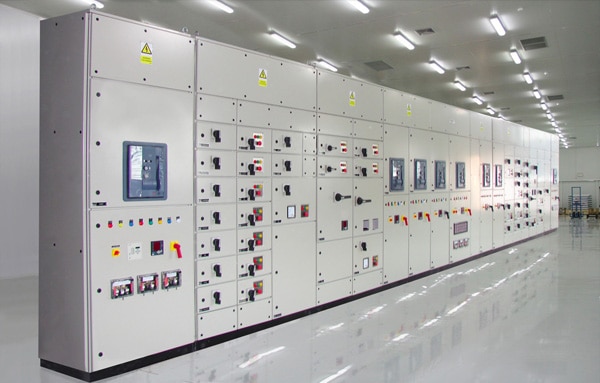 | DISTRIBUTION BOARD & CONTROL PANEL DISTRIBUTION BOARD & CONTROL PANEL We Design and Market: Low Voltage: custom-built switchboards for industrial & other application. View product → |
Frequently asked questions
What project information should you give an electrical control panel supplier?
Provide the load schedule, single-line diagram, prospective fault level, motor list, utility incomer details, expansion allowance, and site conditions.
Which technical requirements belong in a panel RFQ?
State the rated voltage and current, short-circuit withstand rating, enclosure IP rating, ambient temperature, busbar material, cable-entry arrangement, control voltage, and required spare capacity.
What design and verification documents should a supplier provide?
Ask for load and fault-current calculations, protection-coordination results, component data sheets, assembly verification records, wiring diagrams, and factory test reports.
How should you compare electrical control panel quotations?
Compare the supplier’s defined scope, exclusions, component brands, testing, delivery, installation support, spares, drawings, commissioning responsibility, and handover documents—not price alone.