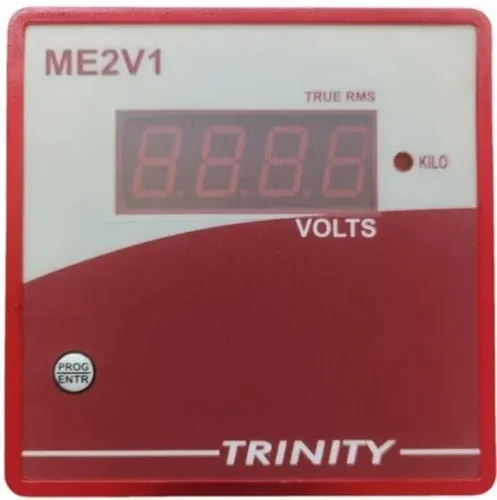
A quoted voltage range does not tell you whether a panel meter suits your 415 V line-to-line, approximately 240 V line-to-neutral plant system. Before ordering, confirm the electrical connection, safety limits, accuracy, installation dimensions, display behaviour and documentation so the instrument can be installed and interpreted correctly.
Key takeaways
- Confirm whether the voltage range covers line-to-line, line-to-neutral, or both.
- Use potential transformers when plant voltage exceeds the meter’s direct-input rating.
- Request accuracy class, response time, wiring diagram, dimensions, and safety ratings.
- Choose a dedicated voltmeter when one stable voltage indication is all you need.
Does the meter match your plant’s voltage system and wiring?
A quoted 25–500 V range is incomplete until the supplier states whether it means line-to-line voltage, line-to-neutral voltage, or both. In a balanced 415 V, three-phase, four-wire star system, line-to-line voltage is about 415 V and line-to-neutral voltage is about 240 V; a meter rated for one measurement is not automatically suitable for the other.
Use these three phase panel voltmeter details as your order check:
1. Ask for the permitted input range in each mode, maximum continuous voltage, short-duration withstand, and frequency range. Confirm whether the display provides V12, V23 and V31, VN1, VN2 and VN3, or both sets.
2. State your connection: three-wire delta, four-wire star, or three-phase four-wire with neutral. Require a wiring diagram showing every terminal number, phase terminals, neutral requirements, phase-sequence assumptions, and recommended upstream protection.
3. Ask the industrial three phase voltmeter supplier what appears when one phase is missing, the neutral is loose, or phase sequence is reversed. The documented result must distinguish a blank display, error code, zero, and retained last value.
4. Confirm whether direct voltage connection is permitted or potential transformers are required. For PTs, request primary and secondary voltage, ratio, burden, insulation level, fuse recommendations, and the scaling method for displayed primary voltage.
5. Request accuracy as a percentage of reading, full scale, or measuring range, plus resolution, temperature influence, and accuracy across the specified voltage and frequency range. Get a calibration certificate when readings support acceptance or protection decisions.
Can you connect it directly, or do you need potential transformers?
A direct connection is suitable only if the industrial three phase voltmeter accepts the panel’s actual voltage. Ask whether its input is direct or requires potential transformers, also called voltage transformers, and whether the stated limit applies line-to-line, line-to-neutral, or both.
If the switchboard voltage exceeds the meter input, obtain these three phase panel voltmeter details:
- PT primary voltage, secondary voltage, ratio, rated burden and insulation level.
- Secondary protection and fuse recommendations for every voltage-sensing circuit.
- The programming or scaling method for displaying primary voltage.
A 3,300 V primary and 110 V secondary PT has a 30:1 ratio. The supplier must explain how the meter will convert its 110 V input into a 3,300 V display. Confirm the meter’s input burden so the PT can supply it without exceeding the PT’s rated load.
Ask whether each fuse belongs on the PT primary, PT secondary or direct meter lead. Do not assume internal meter protection protects switchboard wiring. Request the marked measurement category, such as CAT III or CAT IV, permitted working voltage, pollution degree and overvoltage withstand.
A display that reads 600 V is not automatically safe on a 600 V distribution circuit.
What accuracy and response behaviour will the reading have?
A quoted accuracy of ±1% is incomplete until the supplier states its basis: percentage of reading, percentage of full scale, or percentage of the entire measuring range. Ask the digital voltmeter supplier for plants to document the conditions behind that figure.
1. Request accuracy across the complete voltage and frequency range, plus reference conditions, resolution, repeatability, temperature influence and calibration interval. If the reading supports plant acceptance or protection decisions, require a calibration or test certificate with traceability.
2. Confirm whether the industrial three phase voltmeter measures true RMS or uses average-responding, RMS-calibrated measurement. True RMS matters on circuits feeding variable-frequency drives, rectifiers and UPS equipment, but it does not guarantee accuracy on every distorted waveform; ask for crest-factor and waveform limits.
3. Require the display update rate, measurement response time and behaviour during undervoltage, overvoltage, phase loss and rapidly fluctuating voltage. A slow display can suit distribution indication while hiding a motor-starting dip.
4. Ask whether the meter stores minimum and maximum values, sags, swells, interruptions, harmonics, voltage unbalance and phase sequence. Many panel voltmeters show live RMS values only and retain no event history.
5. Obtain the input burden or impedance and confirm whether potential-transformer scaling affects accuracy. A specification that omits these details cannot support a reliable comparison between quotations.
Will the instrument physically and safely fit the panel?
Approve the model only after its drawing fits the actual door, wiring space and safety requirements—not merely the panel cutout.
1. Obtain the cutout, bezel, mounting depth, terminal size, rear clearance and fixing method. Compare them with door thickness, gland plate, wiring ducts and nearby breakers. Treat these as essential three phase panel voltmeter details before fabrication.
2. Confirm the auxiliary supply voltage and isolation procedure. Ask whether voltage inputs remain live when the display supply is switched off, and require the wiring diagram to show upstream isolation and protective devices.
3. Ask the digital voltmeter supplier for plants to state operating temperature, humidity, altitude derating, vibration resistance, front-panel IP rating and rear-terminal protection. IP54 or IP65 on the bezel does not protect terminals inside a dusty or wet enclosure.
4. Check viewing angle, brightness and contrast at the final door location, including direct sunlight and low-light operation. Then attach the meter’s safety and EMC declarations to the switchboard file, but do not treat them as proof that the completed assembly complies. The panel builder must verify clearances, wiring and assembly requirements.
When is a dedicated voltmeter better than a selector or multifunction meter?
A dedicated industrial three phase voltmeter is better when the operator must diagnose faults quickly from the panel. It shows all phase values together, reducing scan time and the chance of forgetting the selector position last used.
| Arrangement | What the operator sees | Best fit and limitation |
|---|---|---|
| Dedicated voltmeter | V12, V23 and V31, or VN1, VN2 and VN3 simultaneously | Fast fault diagnosis; exposes the affected leg without rotating a switch |
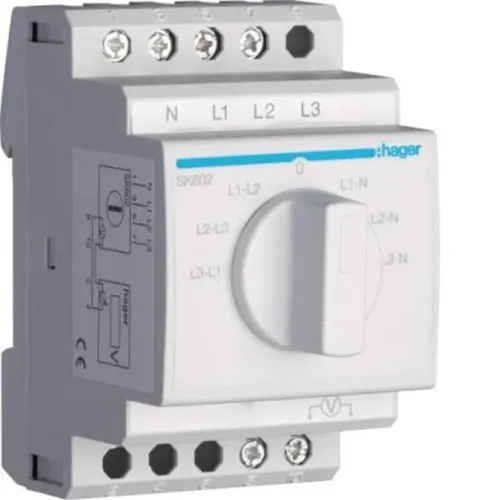
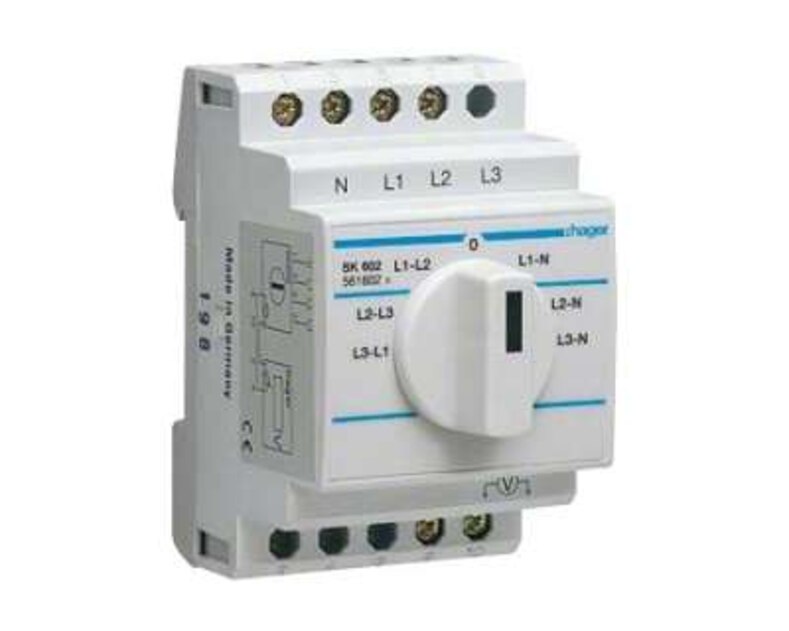
| Selector switch with one single-phase voltmeter | One selected phase at a time | Uses less panel space and costs less, but a brief imbalance can disappear between readings or the operator can read the wrong phase |
| VAF or multifunction meter | Voltage plus current, frequency, kilowatts, energy and communications | Suits plants using these measurements; extra configuration and commissioning effort is wasted if the functions remain unused |
Choose the dedicated meter when an operator needs immediate phase comparison. Choose the selector when space and basic indication matter more than diagnostic speed.
Choose a VAF or multifunction meter only when the plant will use its additional functions. Ask the digital voltmeter supplier for plants to state whether communications deliver instantaneous RMS voltage, an averaged value or a periodically updated register.
- Request the protocol, isolation, address settings, update interval and failure behaviour.
- Do not treat RS485 or Modbus alone as proof of SCADA interoperability.
- Ask explicitly about event recording, minimum and maximum values, interruptions, sags, swells, harmonics, unbalance and phase sequence; a live RMS display is not automatically a power-quality analyser.
Which documents should be attached to the quotation?
Do not approve a quotation that says only “digital AC voltmeter.” Ask the digital voltmeter supplier for plants to attach a sample nameplate, current datasheet revision, terminal layout, wiring diagram and dimensional drawing. The nameplate must show input mode, frequency, safety category, auxiliary supply, and serial or model identification.
- State the exact connection: 3-wire delta, 4-wire star, or neutral-connected 3-phase 4-wire.
- Require the display description: line-to-line values, line-to-neutral values, or both.
- Request auxiliary-supply voltage, isolation details, warranty terms, calibration certificate with traceability, and replacement lead time.
- Make the drawing show cutout, overall depth, terminal access and recommended fuse placement before panel fabrication.
| Document | Confirm | Prevents |
|---|---|---|
| Sample nameplate | Input mode, frequency, safety category, supply and model or serial number | A visually similar meter with incompatible inputs |
| Datasheet and terminals | Revision number, terminal ratings, input range and connection type | Ordering against obsolete specifications |
| Wiring diagram | Phase terminals, neutral requirement, phase sequence and upstream fuses | Miswiring or unprotected sensing leads |
| Dimensional drawing | Cutout, depth, rear clearance and terminal access | Reworking the panel door |
| Calibration and warranty documents | Traceability, validity, exclusions and replacement process | Disputed readings or unsupported repairs |
When comparing a three phase voltmeter supplier in Nagpur, give every bidder 415 V line-to-line, approximately 240 V line-to-neutral, frequency, fault level, enclosure conditions, display values and communication needs. Contact Electrical & Automation Pvt Ltd belongs in that comparison only when its documented meter, wiring, protection and completed assembly match those facts.
Related products
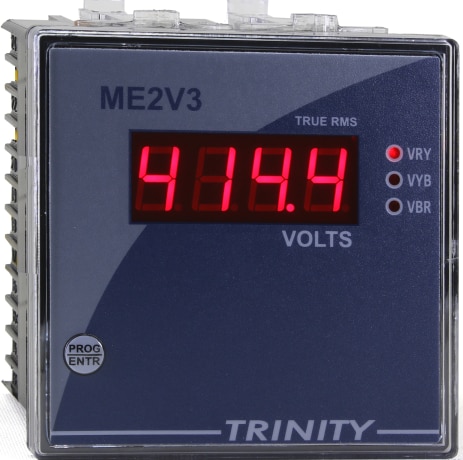 | THREE PHASE VOLTMETER (ME2V3) Volts (25-500V AC) of three phase on 0.56" seven segments LED. View product → |
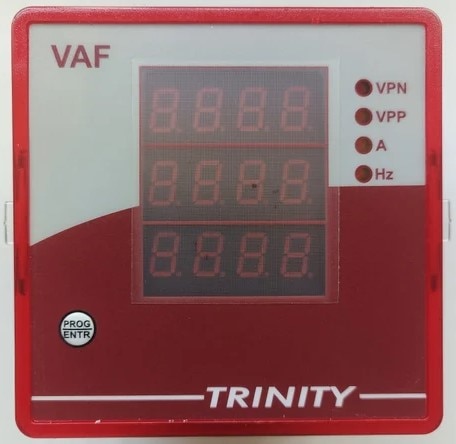 | DIGITAL PANEL METER, MODEL:VAF DIGITAL PANEL METER, MODEL:VAF A VAF meter (Voltage, Amperage, Frequency) is a digital panel-mounted instrument used to measure, monitor, and display key electrical parameters in... View product → |
Frequently asked questions
How do I confirm that a three-phase voltmeter matches my plant’s wiring?
Ask whether its range applies to line-to-line voltage, line-to-neutral voltage, or both, then match it to the system. In a 415 V, three-phase, four-wire star system, readings are about 415 V line-to-line and 240 V line-to-neutral.
When are potential transformers required for a three-phase voltmeter?
Use potential transformers when the plant voltage exceeds the meter’s direct-input rating or when isolation and standardised secondary voltage are required. Confirm the transformer ratio, burden, accuracy class, fuse arrangement, and meter scaling.
What accuracy and response details should I request?
Request the accuracy class or percentage error, measurement range, frequency range, sampling or update rate, display resolution, and response behaviour during voltage changes. These details show whether the meter suits routine indication or disturbance monitoring.
What documents should accompany a three-phase voltmeter quotation?
Request the datasheet, wiring diagram, cutout and overall dimensions, terminal details, input and output ratings, safety information, calibration certificate options, warranty terms, and a clearly stated bill of materials.
Related product
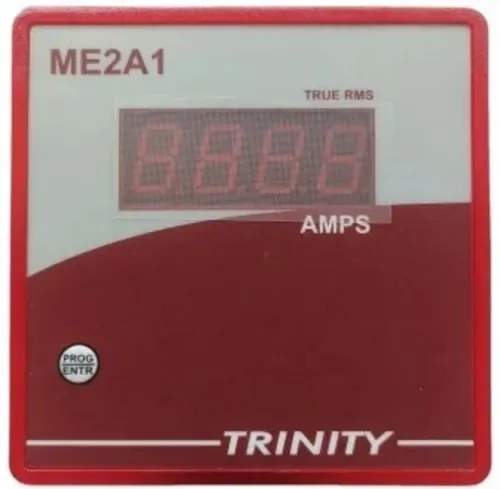
 | SINGLE PHASE AMMETER (ME2A1) AMPS (0-5000A AC) Of One phase on 0.56" seven segment LED View product → |
Keywords