Choosing a three-phase ammeter for a factory panel starts with the current transformers, not the meter face. By the end, you will know how to specify the CT ratio, verify the instrument’s electrical and mechanical fit, and compare a dedicated ammeter with a multifunction meter before requesting a quotation.
Key takeaways
- Connect the meter through three CTs unless it accepts feeder current directly.
- Specify ME2A3 input, accuracy, auxiliary supply, range and panel cutout dimensions.
- Match CT ratio, secondary current and burden to the ammeter before ordering.
- Send feeder data, panel photos and installation dimensions for an accurate quotation.
How should a three-phase ammeter connect to a factory feeder?
A panel ammeter normally connects through three external current transformers (CTs), not directly in series with the feeder. The meter receives 1 A or 5 A secondary current from each CT; direct connection is suitable only when the instrument explicitly accepts feeder current.
A 400/5 A CT produces 2.5 A secondary current at 200 A primary current.
Choose the ratio from expected operating current, not the breaker rating. An oversized ratio wastes display resolution and increases percentage error at normal load.
| Application | CT selection |
|---|---|
| Incomer | Match the highest sustained plant load, with headroom for expansion. |
| Motor starter | Base the ratio on motor full-load current and starting conditions. |
| Bus coupler | Use the maximum current that can transfer through the coupler. |
| Outgoing feeder | Base it on the connected load and measured peak demand, not breaker size. |
Specify CT class, rated burden in VA, lead length, and conductor size together. Long 5 A secondary leads create more burden, so compare cable and terminal burden with the CT rating. Mark primary polarity P1 toward the source and P2 toward the load; connect S1 and S2 consistently to the meter.
Provide a shorting terminal block or CT test block. Never leave a CT secondary open while its primary is energised: dangerous voltage can damage insulation and equipment. A three-wire motor feeder needs no neutral for current sensing, although the meter’s auxiliary supply may require one.
For a three phase ammeter in Nagpur or an industrial current meter in Nagpur, confirm the CT interface and ratio on the wiring diagram before ordering.
Which ME2A3 specifications must appear on the quotation?
The 0–5000 A marking does not prove that the ME2A3 accepts 5000 A directly. Ask which of these meanings applies:
| Meaning | What the quotation must state | Risk if unclear |
|---|---|---|
| Primary-current range | CT ratio, such as 500/5 A, used to scale the display | The displayed value can be wrong |
| Selectable configuration | Available primary ranges and selected setting | The panel may receive the wrong scale |
| Display limit only | Actual CT input and maximum indicated value | 5000 A may be only a software limit |
Require the quotation to identify:
- CT secondary input: 1 A or 5 A
- Input burden, accuracy class, measurement error, 50 Hz compatibility, sampling method, and response time
- Whether measurement is true RMS with distorted waveforms from variable-frequency drives or rectifiers
- Auxiliary supply voltage, power consumption, supply fuse or protection, and display behaviour when control power fails
- Whether all three currents appear simultaneously or one meter cycles through L1, L2, and L3 using a selector button
ME2A3 is a model designation, not a universal standard. An ME2A3 ammeter supplier must provide the exact datasheet, nameplate details, wiring diagram, and revision supplied for your panel. A buyer seeking a three phase ammeter in Nagpur should reject any quotation that gives only “0–5000 A” without these details.
How do you confirm the ammeter will physically and safely fit?
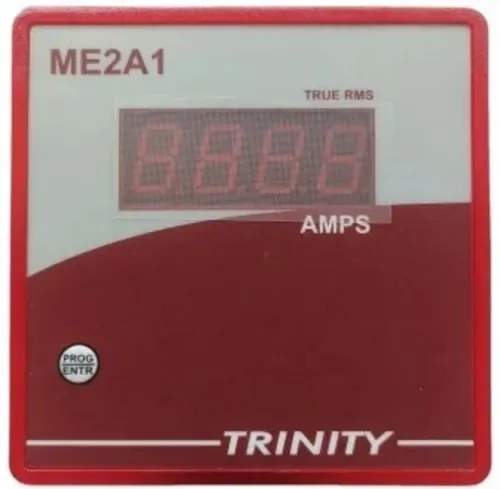
A three phase ammeter supplier in Nagpur for factory panels must provide more than a front-display photograph. Confirm the panel cut-out width and height, bezel dimensions, mounting depth, clamp or screw arrangement, terminal layout, terminal wire-size limits, clearance behind the door, auxiliary-supply voltage, and stated front-panel IP protection rating.
Two instruments called 96 mm units can still have different cut-outs or rear depths.
Request a dimensional and wiring drawing that shows:
- CT input terminals, P1/P2 and S1/S2 polarity marks, auxiliary supply terminals, and every neutral or voltage-sense connection
- Whether the three-wire motor feeder needs no neutral for current sensing, while the meter may still need one for supply or voltage measurement
- CT lead length, conductor size, terminal burden, and the meter’s input burden; compare their total VA with the CT’s rated burden, especially on long 5 A circuits
- A commissioning record for L1, L2, and L3 at a defined operating load; one averaged value or one clamp-meter reading can hide a heavily loaded phase
- CT polarity verification before sharing CTs with power, energy, differential, or directional devices, because reversed polarity can corrupt power-factor and power-direction readings
| Secondary circuit | Installation consequence | Check |
|---|---|---|
| 1 A CT | Lower lead burden over long runs | Confirm meter accepts 1 A |
| 5 A CT | Lead burden rises with cable resistance | Compare total VA with CT rating |
| Either | Extra terminals and connected devices add burden | Record cable and terminal lengths |
When is a dedicated ammeter enough for the panel?
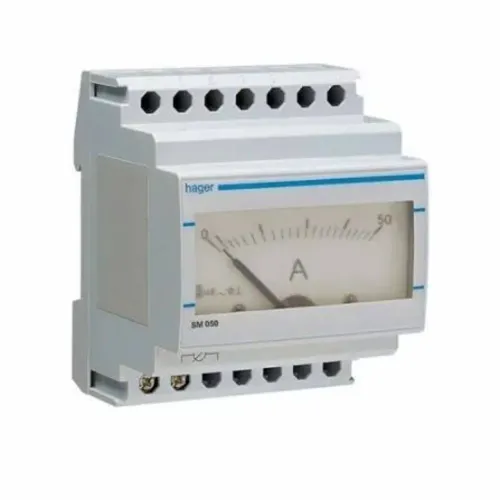
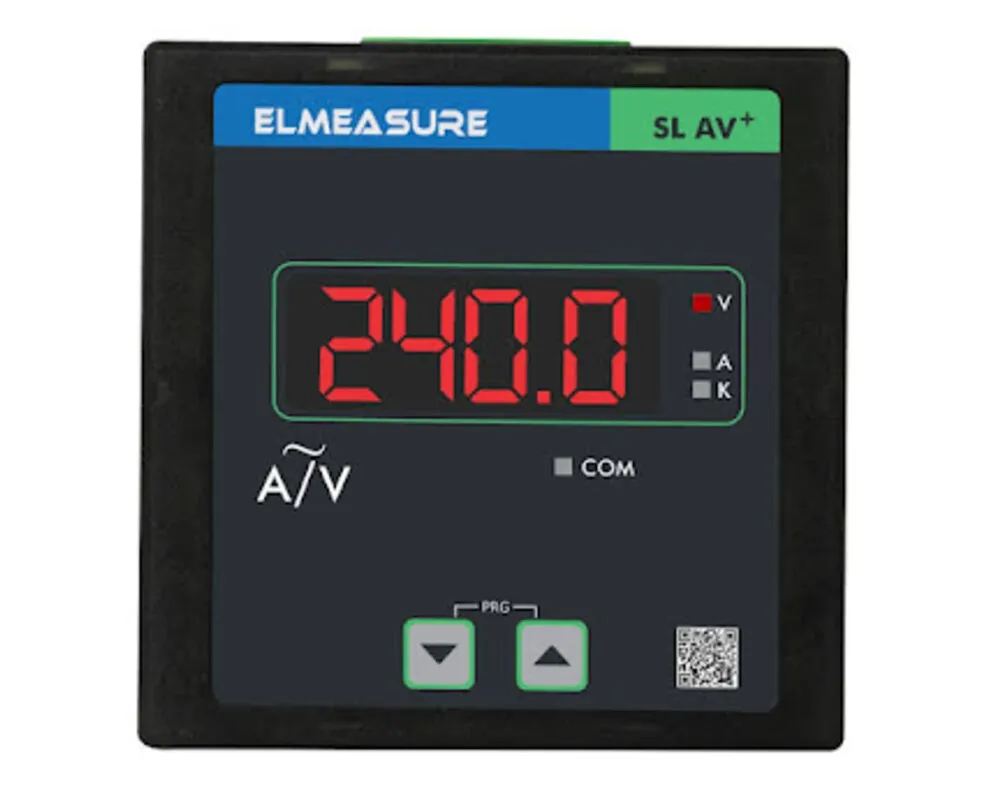
A dedicated ammeter is enough when the panel only needs current indication for routine operation and commissioning. Choose three simultaneous displays when operators must compare L1, L2, and L3 continuously; choose a selector marked L1-L2-L3 or R-Y-B when space and purchase cost matter more than instant comparison.
| Arrangement | Benefit | Limitation |
|---|---|---|
| Three displays | Phase imbalance is visible at a glance | Uses more door space and costs more |
| One ammeter with selector | Saves panel space and cost | Hides two phases at each reading and adds switch contacts and wiring points |
Ask whether the job requires any of these functions:
- Maximum-demand measurement or peak-current capture
- High- or low-current alarms and relay outputs
- Analogue output, Modbus, event memory, or data logging
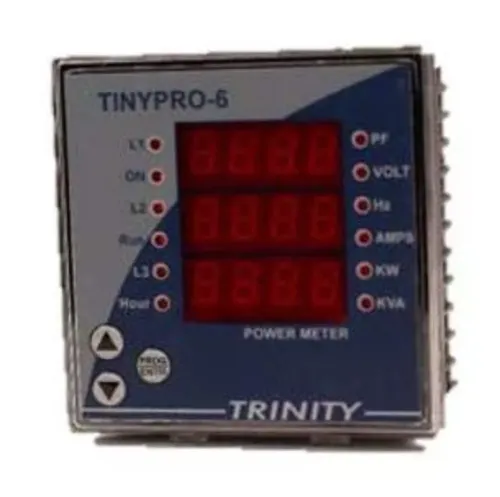
If one is required, compare the dedicated ammeter with a multifunction panel meter such as an MFM. Do not assume a basic industrial current meter in Nagpur can be expanded later; confirm those functions in the datasheet before choosing an ME2A3 ammeter supplier.
An ammeter only indicates current. It does not provide overload, short-circuit, earth-fault, or phase-loss protection; breakers, fuses, overload relays, protection relays, or monitoring relays still need correct selection.
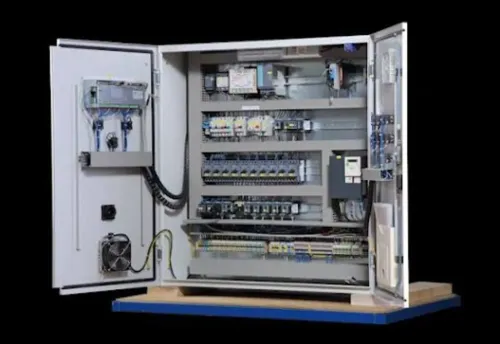
For a motor-control panel, match the meter to the operator’s need to see all phase currents, the control system’s communications requirements, and the maintenance team’s commissioning method.
What should you send a Nagpur supplier before requesting a price?
Send a complete panel schedule, not just “three phase ammeter supplier in Nagpur factory panels.” Location does not establish electrical compatibility; the schedule does.
1. State the system voltage, 50 Hz frequency, feeder or motor full-load current, maximum expected current, breaker rating, CT primary and secondary ratio such as 200/5 A, CT class and burden, cable length, number of displayed phases, auxiliary supply, required accuracy, ambient temperature, enclosure conditions, cut-out dimensions, rear clearance, and required communications or alarms.
Include whether the CT secondary is 1 A or 5 A.
2. Request the exact datasheet, dimensional drawing, terminal diagram, CT wiring guidance, accuracy statement, and a written list of included accessories, including shorting terminals or a CT test block. Ask the ME2A3 ammeter supplier to confirm whether the stated 0–5000 A is a CT-scaled primary range, a selectable configuration, or only a display limit.
3. Compare quotations only when each proposed meter is tied to your panel schedule. Contact Electrical & Automation Pvt Ltd can be considered alongside other local options if its ME2A3 or proposed alternative identifies the CT interface, supply, cut-out, accuracy, and documentation instead of quoting only a model name.
This approach helps an industrial current meter in Nagpur reach site ready for the actual panel.
Related product
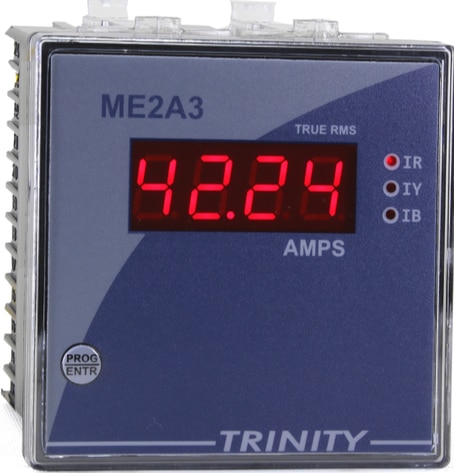 | THREE PHASE AMMETER (ME2A3) Amps (0-5000A AC) of three phase on 0.56" seven segment LED View product → |
Frequently asked questions
How should a three-phase ammeter connect to a factory feeder?
Connect it through three external current transformers, with each CT supplying the meter with a 1 A or 5 A secondary current. Connect the meter directly in series only when its specifications explicitly accept the feeder current.
Which ME2A3 specifications must appear on the quotation?
Request the exact model, CT secondary input of 1 A or 5 A, measurement range, accuracy class, auxiliary supply voltage, frequency, display format, terminal arrangement and panel cutout dimensions.
How do you confirm the ammeter will physically and safely fit?
Compare the instrument’s bezel, depth, panel cutout, terminal clearance and mounting method with the available panel space. Confirm CT wiring, insulation ratings, fuse or shorting provisions and safe access for testing.
When is a dedicated ammeter enough for the panel?
A dedicated ammeter is enough when operators only need local phase-current readings and the panel already has suitable CTs, wiring and protection. Add multifunction metering when you need voltage, power, energy, demand or power-factor data.
What should you send a Nagpur supplier before requesting a price?
Send the feeder current, system voltage and frequency, CT ratios and secondary current, auxiliary supply, ME2A3 model or required functions, panel cutout measurements, quantity, delivery location and clear panel photos.
Keywords