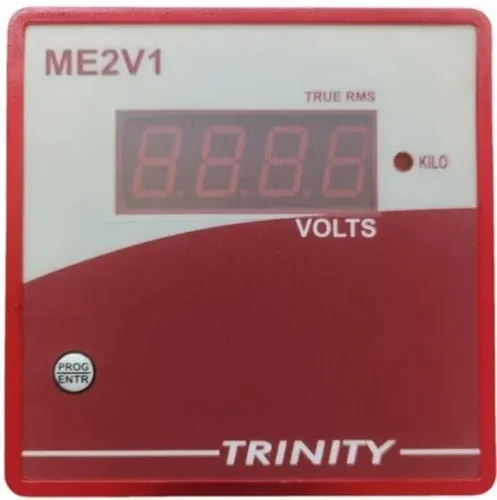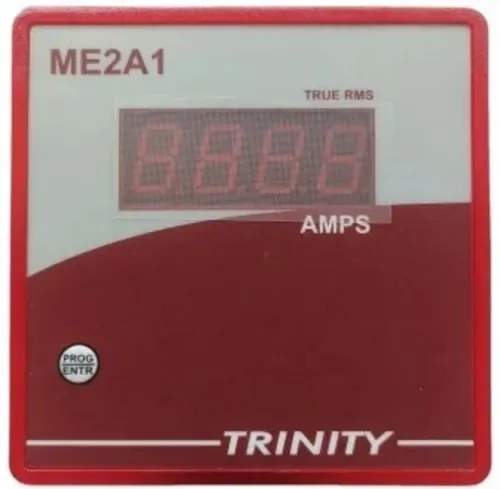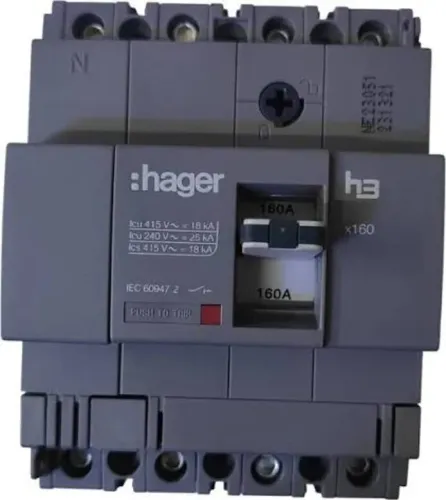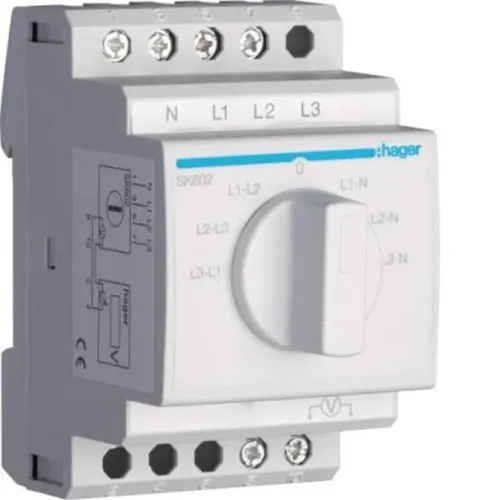
Choosing a three-phase panel voltmeter starts with the circuit you will measure, not the display size or product name. By the end, you will be able to specify the wiring system, voltage range, protection, measurement performance, panel fit and documents required for a safe comparison.
Key takeaways
- Specify 3P3W line-to-line or 3P4W line-to-neutral measurement.
- State whether sensing is direct or through VTs/PTs.
- Confirm input range, accuracy, cutout size, and terminal arrangement.
- Include system details, quantity, display preference, and delivery location in your enquiry.
Match the voltmeter to the three-phase circuit
A voltmeter must match both the circuit connection and the voltage appearing at its terminals. Specify whether it will measure line-to-line voltage on a 3P3W system, or line-to-neutral voltage on a 3P4W system. Also state whether the connection is direct or through voltage transformers (VTs/PTs).
| Circuit and connection | What the meter receives | Selection point |
|---|---|---|
| 415 V, 3P3W, direct | About 415 V AC line-to-line | Use a range covering the maximum permitted voltage and transients |
| 415/230 V, 3P4W, direct | 415 V line-to-line or 230 V line-to-neutral | Confirm which voltage the input terminals measure |
| PT secondary | A reduced voltage such as 110 V AC | Specify PT ratio, secondary voltage, accuracy class, burden and scaling |
| Circuit above the meter rating | Voltage exceeding its input insulation or range | Do not connect directly; use a correctly rated PT |
A 25–500 V AC range covers 415 V line-to-line and 230 V line-to-neutral only when the meter’s connection, insulation rating and maximum input permit those readings. It does not suit a system above 500 V. A direct-connected instrument also needs stated input impedance; excessive loading can distort a lightly loaded sensing circuit or PT secondary.
Your enquiry to a panel mounted voltmeter supplier in Nagpur for three phase systems should identify:
- 3P3W or 3P4W wiring and neutral availability
- Nominal and maximum voltage, frequency and measurement points
- Direct input or PT connection, including ratio and secondary voltage
- Required display units, auxiliary supply and input burden
- Whether one selected phase pair or all three voltages must appear simultaneously
Wire the sensing circuit with protection and isolation
Connect the voltmeter in parallel with the circuit, never in series. On a 415 V three-phase, four-wire system, connect phase-to-neutral for approximately 230 V readings or phase-to-phase for approximately 415 V readings, according to the wiring diagram. A 25–500 V AC input range suits these values; circuits above 500 V need a voltage transformer.
- Isolate the switchboard, lock out the supply, and prove dead with a calibrated test instrument before touching sensing conductors.
- Install appropriately rated fuses or miniature circuit-breakers close to the source. Coordinate their voltage rating, interrupting capacity, conductor size, and the meter’s permitted input; the meter’s internal fuse does not replace panel-side protection.
- Terminate wires in insulated ferrules or terminals, maintain enclosure clearances, and prevent exposed sensing parts from contacting the panel body.
- Check every connection and phase identification before restoring power. Re-test the measured voltage after energising.
- Ask an industrial panel voltmeter supplier for the wiring diagram, dimensional drawing, declared accuracy, calibration or test certificate, operating-temperature range, warranty terms, and input impedance or burden.
A selector-switch meter displays one phase or phase pair at a time, so it can miss brief phase loss or voltage unbalance. Use simultaneous three-channel measurement or a phase-monitoring relay when those faults require detection.
For medium-voltage circuits or inputs below system voltage, use a voltage transformer with the specified ratio, secondary voltage, accuracy class, burden, insulation level, and scaled meter setting.
Check measurement performance and physical panel fit
Accuracy starts with matching the meter’s input to the voltage it will actually measure. A 25–500 V AC range suits direct line-to-line measurement on a 415 V system only when 500 V is the specified maximum input and the meter supports the system frequency. The same system produces about 230 V line-to-neutral.
| Check | Direct voltage connection | Voltage-transformer connection |
|---|---|---|
| Meter input | Must cover the measured line-to-line or line-to-neutral voltage | Must match the transformer secondary, such as 100 V or 110 V |
| Configuration | Select 3P3W for systems without neutral; select 3P4W for phase-to-neutral readings | Specify the primary-to-secondary ratio and set the meter scaling |
| Accuracy evidence | Request accuracy class, frequency range, and input impedance or burden | Request transformer accuracy class, burden, insulation level, and the meter’s combined scaling accuracy |
| Use limit | Do not connect directly above the meter’s rated input | Use a VT/PT for medium-voltage circuits or any circuit above the meter input rating |
For a replacement, measure the rectangular cut-out rather than relying on the bezel dimensions. Confirm panel thickness, mounting clips or screws, terminal pitch, rear depth, wiring direction, and the front IP rating; one mismatched dimension can stop a correctly rated meter from seating.
Request the terminal diagram before ordering. It must show phase inputs, neutral requirements, auxiliary supply, fuse connections, and any selector-switch wiring. Confirm that the instrument’s display units, decimal resolution, and reading method match the panel’s operating needs.
Choose the right display and monitoring architecture
Choose a dedicated three-phase voltmeter when your decision is limited to local voltage indication and you need a fast, simple reading without current, power, energy or control data. It is preferable to a selector meter when a brief phase loss or voltage unbalance must not disappear between switch positions.
| Option | What it shows | When it applies |
|---|---|---|
| Dedicated three-phase voltmeter | Voltage only, with the display arrangement stated on its datasheet | Basic local indication where no added monitoring is needed |
| Selector voltmeter | One selected phase or phase pair at a time | Low-cost inspection where simultaneous comparison is not important |
| Three-display instrument | All three voltages simultaneously | Detecting phase loss, severe unbalance or intermittent connections |
| VAF meter | Voltage, current and frequency | Troubleshooting or operating equipment where those three values matter |
| Energy meter | Voltage plus current, power, power factor and accumulated energy | Consumption, billing allocation or load-performance records |
| PLC transducer | Scaled electrical values for a controller or SCADA system | Remote alarms, trending and automatic control |
A search for a three phase voltmeter in Nagpur is incomplete until you confirm whether the instrument displays all channels or uses internal switching. Check the model datasheet; “ME2V3” alone does not identify that architecture.
Voltage magnitude does not prove phase rotation. Add a phase-sequence indicator, or specify a meter with an explicitly stated phase-rotation function, before connecting a motor. Choose simultaneous measurement when a selector could hide the fault you need to catch.
Turn a Nagpur supplier search into a complete purchase enquiry
A complete enquiry prevents an ME2V3 quote from hiding a wiring mismatch. State the board application, measurement points, and installation conditions before asking for price.
1. Give the system details: 400/415 V low-voltage board, transformer secondary, or PT secondary; 3P3W or 3P4W; line-to-line or line-to-neutral measurement; nominal and maximum voltage; 50 or 60 Hz; neutral availability; and direct connection or voltage-transformer connection.
2. Ask the me2v3 voltmeter dealer in nagpur to confirm the exact model suffix and provide the manufacturer’s datasheet. The quotation must show input range, declared accuracy, auxiliary supply, insulation rating, terminal arrangement, fuse or MCB recommendation, scaling for a PT secondary, display units, and whether alarms or communications are included.
3. Request the wiring and installation documents: terminal diagram, dimensional drawing, panel cut-out dimensions, mounting depth, terminal clearances, and connection instructions. A catalogue photograph cannot confirm whether the instrument fits your door or accepts your cable size.
4. Request a calibration or routine-test certificate, operating-temperature and humidity limits, warranty period, replacement process, and delivery terms. Ask who will verify the programmed ratio when the meter connects through a PT.
Contact Electrical & Automation Pvt Ltd can be included in the comparison if its quotation identifies these application-specific details rather than relying only on the ME2V3 product name. Reject any offer that omits the input configuration, terminal diagram, or exact cut-out.
Related products
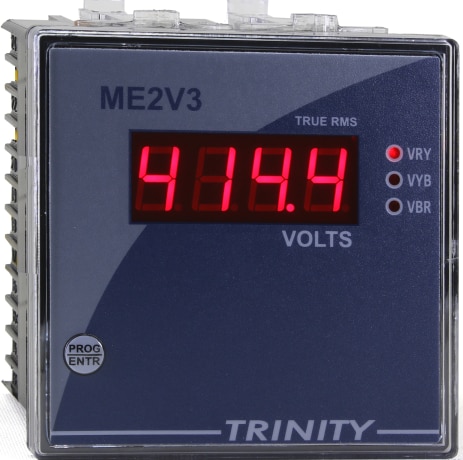 | THREE PHASE VOLTMETER (ME2V3) Volts (25-500V AC) of three phase on 0.56" seven segments LED. View product → |
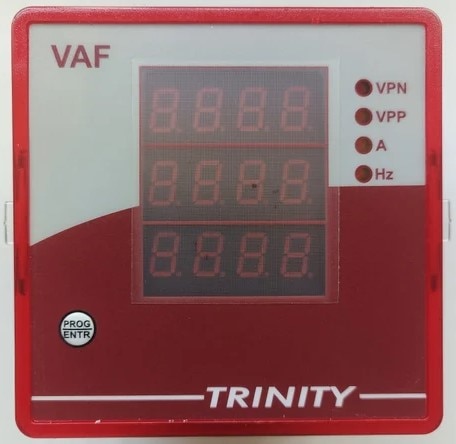 | DIGITAL PANEL METER, MODEL:VAF DIGITAL PANEL METER, MODEL:VAF A VAF meter (Voltage, Amperage, Frequency) is a digital panel-mounted instrument used to measure, monitor, and display key electrical parameters in... View product → |
Frequently asked questions
How do you match a panel voltmeter to a three-phase system?
Identify whether the circuit is 3P3W or 3P4W, then specify line-to-line or line-to-neutral measurement. State the nominal voltage and whether the meter connects directly or through VTs/PTs.
How should the voltmeter sensing circuit be protected?
Use appropriately rated fuses or miniature circuit breakers in the sensing leads, provide an isolating means, and follow the meter and VT wiring diagram. Never short-circuit a VT secondary or work on live terminals.
Which specifications confirm that a panel voltmeter will fit?
Check the measurement range, accuracy, frequency range, display type, panel cutout dimensions, front protection rating, terminal layout, and depth behind the panel.
What should a purchase enquiry to a Nagpur supplier include?
Include the circuit type, voltage and frequency, direct or VT input, required accuracy, display preference, cutout size, quantity, auxiliary supply, wiring requirements, and delivery location.
Related product
 | SINGLE PHASE AMMETER (ME2A1) AMPS (0-5000A AC) Of One phase on 0.56" seven segment LED View product → |
Keywords