Choosing an MCCB by amperage alone can leave a cable underprotected, a motor unable to start, or a breaker unable to interrupt the available fault current. Use the load calculation, conductor ampacity, fault level, trip-unit settings and coordination data together to specify a breaker that fits the installation rather than merely matching a number on a catalogue page.
Key takeaways
- Select a trip rating above design current but below corrected cable ampacity.
- Treat 16A to 1600A as standard trip steps, not interchangeable frame sizes.
- Match poles, system voltage and kA short-circuit capacity to the installation.
- Give the dealer load, cable, fault-level and coordination details before ordering.
How to turn calculated load current into an MCCB rating
Choose the smallest standard trip rating that is at least the calculated design current, while remaining no higher than the conductor’s permitted ampacity after temperature, grouping and installation corrections. A larger MCCB does not create useful margin; it can leave the cable underprotected and reduce fault discrimination.
For a balanced three-phase load, calculate:
I = P ÷ (√3 × V × η × pf)
Use watts, line-to-line volts, efficiency η and power factor pf. Then apply the project’s stated continuous-load and design allowances, not an arbitrary percentage. For a motor, check full-load current, starting current, locked-rotor current and starting time separately. A breaker sized only for running current can nuisance-trip during acceleration; overload protection still needs its own setting.
Industrial MCCB sizes are frame-and-trip combinations, not a universal list. Confirm the manufacturer’s series and classification, especially for 16 A products.
| Rating examples | What to verify |
|---|---|
| 16, 25, 32, 40, 50, 63 A | MCCB or MCB classification and fixed trip |
| 80, 100, 125, 160, 200, 250 A | Frame rating, In and thermal-magnetic range |
| 320, 400, 500, 630, 800 A | Electronic-trip availability and adjustable Ir |
| 1,000, 1,250, 1,600 A | Busbar, cable termination and installation capacity |
For sound mccb current rating selection, record the frame rating, trip-unit rating In and actual long-time pickup Ir. A 250 A frame set to Ir 200 A is not equivalent to a fixed 250 A device.
What the common 16 A to 1,600 A rating steps actually mean
A 16 A to 1,600 A catalogue is not a universal MCCB range. Manufacturers choose different frame sizes and trip steps; 16 A devices may be classified as MCBs, compact breakers or MCCBs. Treat “industrial MCCB sizes” as frame-and-trip combinations, not a current list.
| Frame rating | Common trip ratings | What you are actually buying |
|---|---|---|
| Small frame | 16, 25, 32, 40, 50, 63, 80, 100 A | The series may use fixed thermal-magnetic trips; confirm whether it is an MCCB under the stated standard |
| Mid-size frame | 100, 125, 160, 200, 250, 320, 400, 500 A | Several In values can share one frame, with different poles, terminals and interrupting capacities |
| Large frame | 400, 500, 630, 800, 1,000, 1,250, 1,600 A | Electronic trips and adjustable long-time settings become common; verify the exact trip unit |
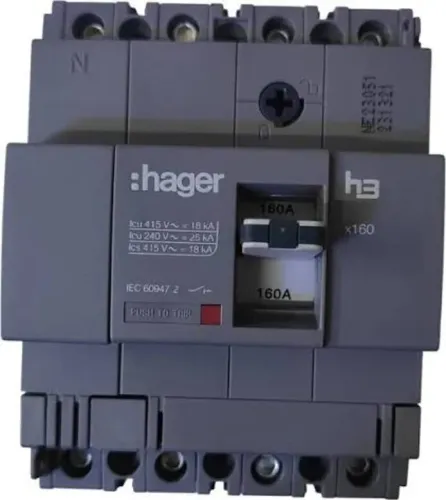
The frame is the breaker body’s maximum design class, while In is the breaker or trip unit’s rated current. A 250 A frame can contain a 160 A trip, and an electronic unit can be set below its nominal rating.
Ir is the selected long-time pickup, so a 250 A trip set to 200 A has an actual long-time setting of 200 A, subject to the manufacturer’s tolerance and time-current curve. A fixed 250 A thermal trip does not offer that same adjustment.
Require the part number, frame, In, Ir range and setting, and trip type. “MCCB dealer ratings 16A to 1600A” is not enough information for a safe comparison.
How to check poles, voltage and short-circuit capacity
A 400 A MCCB is not suitable simply because the load is near 400 A. Check the circuit conductors, number of live conductors, system voltage and prospective fault current before ordering; that is the basis of safe mccb current rating selection.
| Item | What to check | Selection rule |
|---|---|---|
| Poles | 2P, 3P or 4P arrangement | Use 3P for three-phase circuits; use 4P when the neutral must be switched and isolated. Never switch a protective earth or PEN conductor. |
| Ue | Rated operational voltage | Match the MCCB’s declared Ue to the system, such as 415 V AC. Do not use a rating stated for 415 V on a different voltage without confirmation. |
| Icu | Ultimate short-circuit breaking capacity | Select a value at least equal to the prospective fault current at the MCCB terminals, at the stated voltage and installation conditions. |
| Ics | Service short-circuit breaking capacity | Check this separately under IEC 60947-2. Ics is not automatically equal to Icu, and it indicates how the breaker performs after interrupting a fault. |
Obtain the site fault level from the source, transformer impedance and fault type. Confirm the manufacturer’s terminal, conductor and busbar conditions; estimated cable impedance cannot replace a fault study where the fault level matters.
A long cable can reduce fault current but still create voltage drop and coordination problems. Also check time-current curves, instantaneous pickup, short-time delay and coordination tables: a higher ampere rating alone does not guarantee discrimination between breakers.
When thermal-magnetic or electronic trips and coordination matter
A motor feeder needs a breaker that tolerates starting current without replacing the motor overload relay. Use thermal-magnetic trips for small, straightforward circuits; use electronic trips on larger feeders and distribution boards where adjustable protection and discrimination matter.
| Application | Preferred trip | Settings and checks |
|---|---|---|
| Motor feeder | Thermal-magnetic or electronic | Check starting current, locked-rotor current, starting time, overload relay and coordination type |
| Feeder | Electronic for larger ratings | Set long-time Ir below cable ampacity and above calculated load; check short-time and instantaneous pickup |
| Distribution board incomer | Electronic where available | Add ground-fault protection, metering or zone-selective interlocking when the scheme requires it |
MCCB current rating selection must state the frame size, trip rating, long-time pickup Ir and trip technology. A 250 A frame with an electronic unit can have Ir set below 250 A; a fixed-thermal 250 A breaker does not offer the same adjustment.
Coordinate protection in this order:
- Compare downstream and upstream time-current curves, not just ampere ratings.
- Check short-time delay, instantaneous pickup and let-through energy against the manufacturer’s coordination tables.
- Confirm that the downstream breaker clears the fault before the upstream device trips; different ratings alone do not guarantee selectivity.
Electronic units also require checks for auxiliary power, sensor arrangement, setting security and accessories. Industrial MCCB sizes are therefore frame-and-trip combinations, not merely a list of nominal currents. A dealer’s quote should show these details.
What to put in an MCCB dealer enquiry before you order
Send the moulded case circuit breaker dealer a site-specific schedule, not “400 A, 36 kA.” Request the following before accepting a quotation:
- Exact manufacturer part number, frame rating, trip rating, poles, system voltage, trip-unit type, and accessories such as shunt trip, undervoltage release, auxiliary contacts and rotary handle.
- Icu and Ics at the stated voltage, checked at the breaker terminals for the specified cable or busbar arrangement.
- Prospective fault current, fault type, transformer impedance and source data from the site fault study. Long cables can reduce fault current, but assumed cable impedance cannot replace that study.
- Conductor ampacity, enclosure type, ambient temperature, altitude and side-by-side spacing. Require the manufacturer’s derating table for hot, crowded or outdoor panels.
- Applicable standard, conformity documents, delivery condition, test records and warranty terms.
| Enquiry item | State this | Why it changes the quote |
|---|---|---|
| Load circuit | Feeder or motor, calculated current, conductor size | Prevents selection from amperage alone |
| Motor duty | Starting current, locked-rotor current, starting time, overload relay and coordination type | The MCCB does not replace motor overload protection |
| Protection scheme | Long-time, short-time, instantaneous and earth-fault settings | Confirms selectivity with upstream and downstream devices |
Whether you contact an MCCB dealer in Nagpur or another supplier, verify that “mccb dealer ratings 16a to 1600a” refers to the manufacturer’s actual frame and trip data, not a universal product category. Contact Electrical & Automation Pvt Ltd can use these details to distinguish a suitable breaker from a nominally similar catalogue option.
Related product
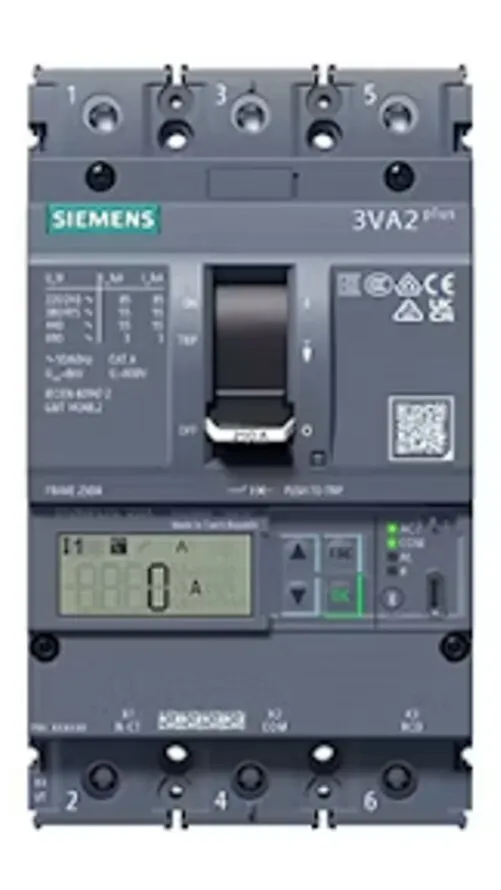
 | LOW VOLTAGE POWER DISTRIBUTION PRODUCTS Moulded Case Circuit Breakers (MCCB) Moulded Case Circuit Breakers (MCCB) 3VA/3VM/3VJ - 16 AMP To 1600 AMP View product → |
Frequently asked questions
How do you convert calculated load current into an MCCB rating?
Choose the smallest standard trip rating at least equal to the design current, after applying load, temperature, grouping and installation corrections. Confirm that the corrected cable ampacity is not lower than the MCCB setting.
What do MCCB ratings from 16A to 1600A mean?
They identify the breaker’s rated current or adjustable trip range. The available steps vary by manufacturer, so confirm the exact frame size, fixed or adjustable trip, and continuous-current setting.
How do you check MCCB poles, voltage and short-circuit capacity?
Match the pole arrangement to the system, such as 3-pole for a three-phase circuit or 4-pole when neutral isolation is required. Check the breaker’s rated operational voltage and interrupting capacity in kA against the prospective short-circuit current at its installation point.
When do thermal-magnetic or electronic MCCB trips matter?
Thermal-magnetic trips suit simpler feeders and combine overload and instantaneous magnetic protection. Electronic trips provide adjustable long-time, short-time, instantaneous and ground-fault functions when selective coordination or closer protection control is required.
What information should you include in an MCCB dealer enquiry?
State the design current, system voltage and frequency, number of poles, fault level, cable size and installation method, load type, trip-unit requirements, enclosure conditions, accessories, and required coordination with upstream and downstream breakers.
Keywords