HRC fuses remain widely used in industrial electrical systems because they provide dependable short-circuit protection in appropriately designed applications. Their relatively simple construction can sometimes create the impression that fuse selection is straightforward, but incorrect rating, fuse class or installation can compromise the intended protection.
A knowledgeable HRC Fuse Supplier should be able to support selection based on circuit requirements rather than only physical dimensions.
Mistake one is choosing by current rating alone
Two fuses carrying the same nominal current may not necessarily have identical characteristics.
Engineers need to consider voltage rating, breaking capacity, utilisation category, time-current behaviour and the type of equipment being protected.
The fuse should protect the circuit without operating unnecessarily during normal transient conditions.
Mistake two is overlooking equipment characteristics
Motor circuits, capacitor circuits, semiconductor applications and general distribution feeders can have different protection requirements.
A motor, for example, may experience substantial current during starting. Selecting a fuse without considering this normal operating condition can result in nuisance operation.
Conversely, oversizing the fuse simply to prevent nuisance blowing may reduce protection effectiveness.
Mistake three is ignoring the fuse base
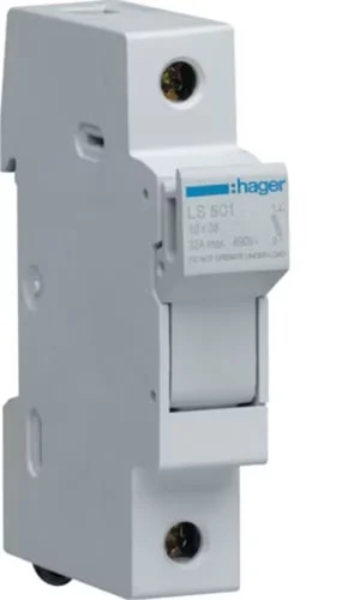
The HRC Fuse Base Supplier requirement is closely connected with fuse selection. The fuse link and its base must be compatible in size, rating and application.
Poor contact at fuse mounting points can contribute to unwanted heating. Engineers and maintenance teams should therefore inspect fuse bases, terminals and connections rather than replacing only the fuse link after repeated problems.
Mistake four is replacing a failed fuse without investigating
A blown fuse is an indication that something occurred in the circuit. Replacing it immediately without checking the cause may expose the system to another interruption.
Maintenance teams should investigate:
- Short-circuit conditions
- Damaged cables
- Faulty equipment
- Loose connections
- Incorrect fuse sizing
- Repeated overload conditions
- Abnormal operating cycles
The fuse is a protective device, not the underlying cause of the electrical fault.
Mistake five is mixing unsuitable replacements
Industrial maintenance teams often keep spare fuses for emergency replacement. Clear identification and organised inventory are essential.
Using a physically compatible but electrically unsuitable fuse can alter the intended protection characteristics. Spare stock should therefore be maintained according to approved equipment schedules.
Nagpur's manufacturing and engineering facilities rely on electrical maintenance teams to keep production systems operational. In these environments, standardising approved fuse ratings and maintaining appropriate replacement inventory can simplify maintenance and reduce selection errors.
Contact Electrical & Automation Pvt. Ltd. supplies industrial electrical products for applications across Nagpur, supporting contractors, panel builders and industrial maintenance requirements.
HRC fuse protection works best when the fuse link, base, conductor and downstream equipment are considered as one coordinated system. Correct selection begins with understanding the circuit duty, while dependable maintenance depends on replacing components according to the original protection requirements rather than making assumptions based only on physical fit.